POUR BUREAUX
BUREAUX & ESPACES DE TRAVAIL
Hydratation intelligente pour des espaces de travail modernes
DISPENSEUR D'EAU INTELLIGENT
Réduire les coûts et augmenter la productivité
GESTIONNAIRES DE BUREAU
Gérez l'hydratation sans aucun tracas
POUR HÔTELS
HÔTELS
Élevez l'expérience de vos invités
Gérez les boissons sans aucun tracas
Rationalisez l'H&R avec Aquablu
SOLUTION
10 TYPES OF WATER DISPENSERS — HOW TO CHOOSE FOR YOUR OFFICE.
8 min
8 min
|
|
24 Jun 26
8 min
|
24 Jun 26

Ten ways to put drinking water in an office, and how to tell which one actually fits yours. The answer comes down to one number most specs get wrong.
There are more ways to put drinking water in an office than most people realise. Countertop, plumbed-in, bottled, wall-mounted, even built into the cabinetry. This guide covers all ten, and where each one actually earns its place.
But the format is the second decision, not the first. Every person in your office uses the hydration setup every single day, and few purchases get judged that fast. Get it right and people reach for it without thinking. Get it wrong and it sits in the corner while the team orders cans again.
What separates the two isn't the type of dispenser. It's whether it's sized to how much your team actually drinks, and that's the number most specs get wrong. Offices of 51 to 100 people average 0.33 litres per person per day. That climbs 2.6× once sparkling and functional flavours go live, because variety turns occasional drinkers into daily ones. (Aquablu AURA fleet data, European install base, past 12 months.) Headcount tells you almost nothing; consumption per person decides whether a compact countertop unit copes or you need a floor-standing tap.
So as you read the ten types below, hold that number, and count the pinch points, not the people. A handful passing a quiet pantry is a different problem from 30 filling bottles before a 10am stand-up. Here's how the ten map to real spaces, supply setups, and team sizes.
Already know you're replacing bottled delivery? See what the right setup costs against your current spend. → Calculate my savings
The 10 Types of Water Dispensers
1. Plumbed-In (Point-of-Use) Dispensers
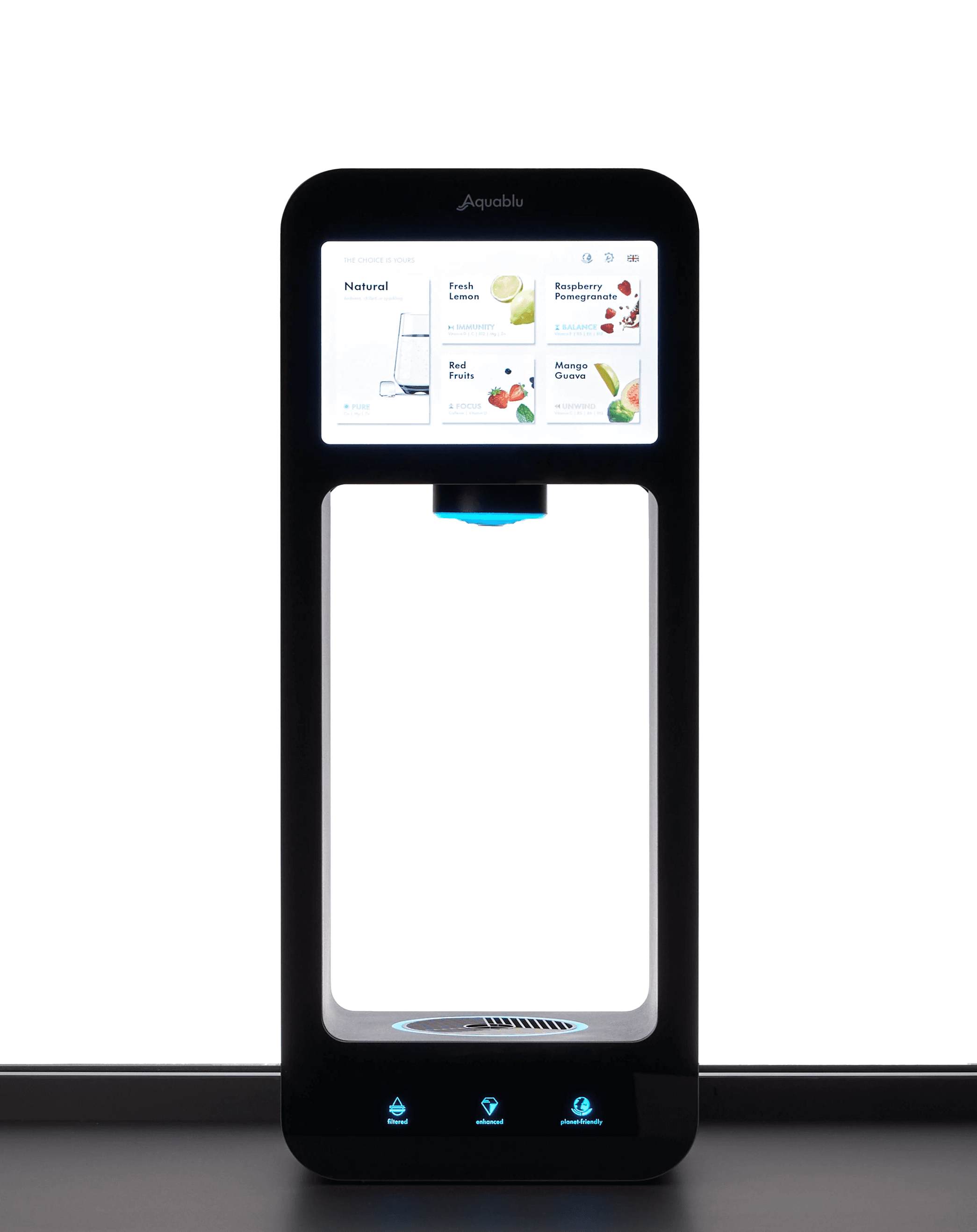
Plumbed-in dispensers connect directly to your building's water supply — no deliveries, no bottle storage, no recycling run. They filter water on demand, removing contaminants like microplastics, bacteria, and heavy metals, and deliver still, chilled, or sparkling water instantly.
Aquablu's REFILL+ connects to your water line and uses Nano-Silver Filtration to remove 99.9% of contaminants, with automatic UV cleaning running continuously at the dispensing point.
Good fit for: offices with plumbing access, hotels with consistent guest traffic, corporate headquarters, any site where daily demand justifies the setup.
Worth knowing: needs professional installation and scheduled filter changes. Higher upfront cost than bottled options.
2. Countertop Dispensers
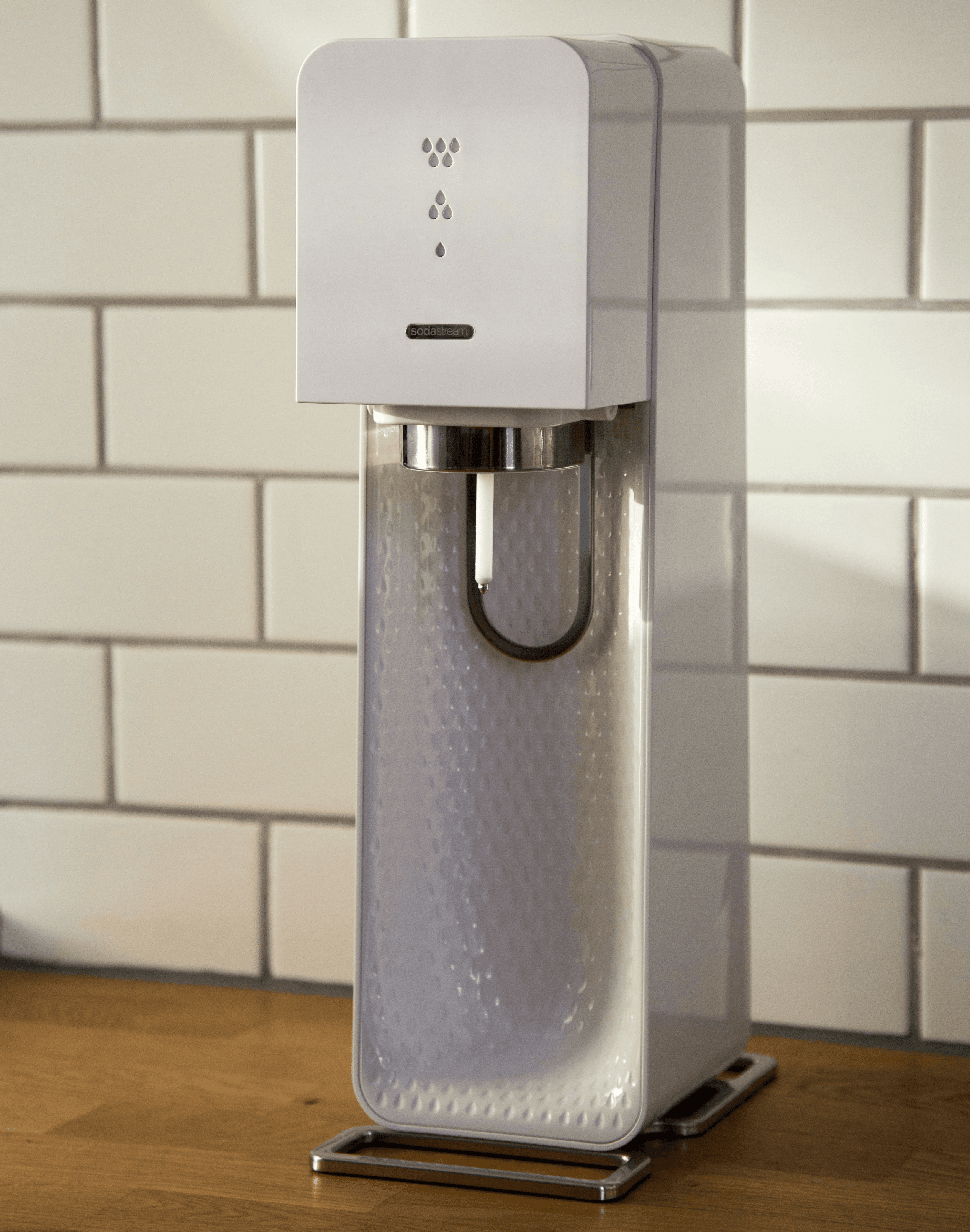
Countertop units sit on a desk, counter, or kitchen surface. They don't take up floor space, work with small bottles or a mains connection, and move easily when layouts change.
Small offices, hotel café areas, and meeting rooms use them well — compact and accessible without requiring a dedicated zone. Many models offer hot and cold, which covers coffee breaks and cold drinks from one point.
Good fit for: teams of five to 15 people, hotel guest lounges, executive suites, conference rooms where counter space is easier to give up than floor space.
Worth knowing: lower water capacity. In busier settings, expect more frequent bottle changes or refills.
3. Freestanding Dispensers
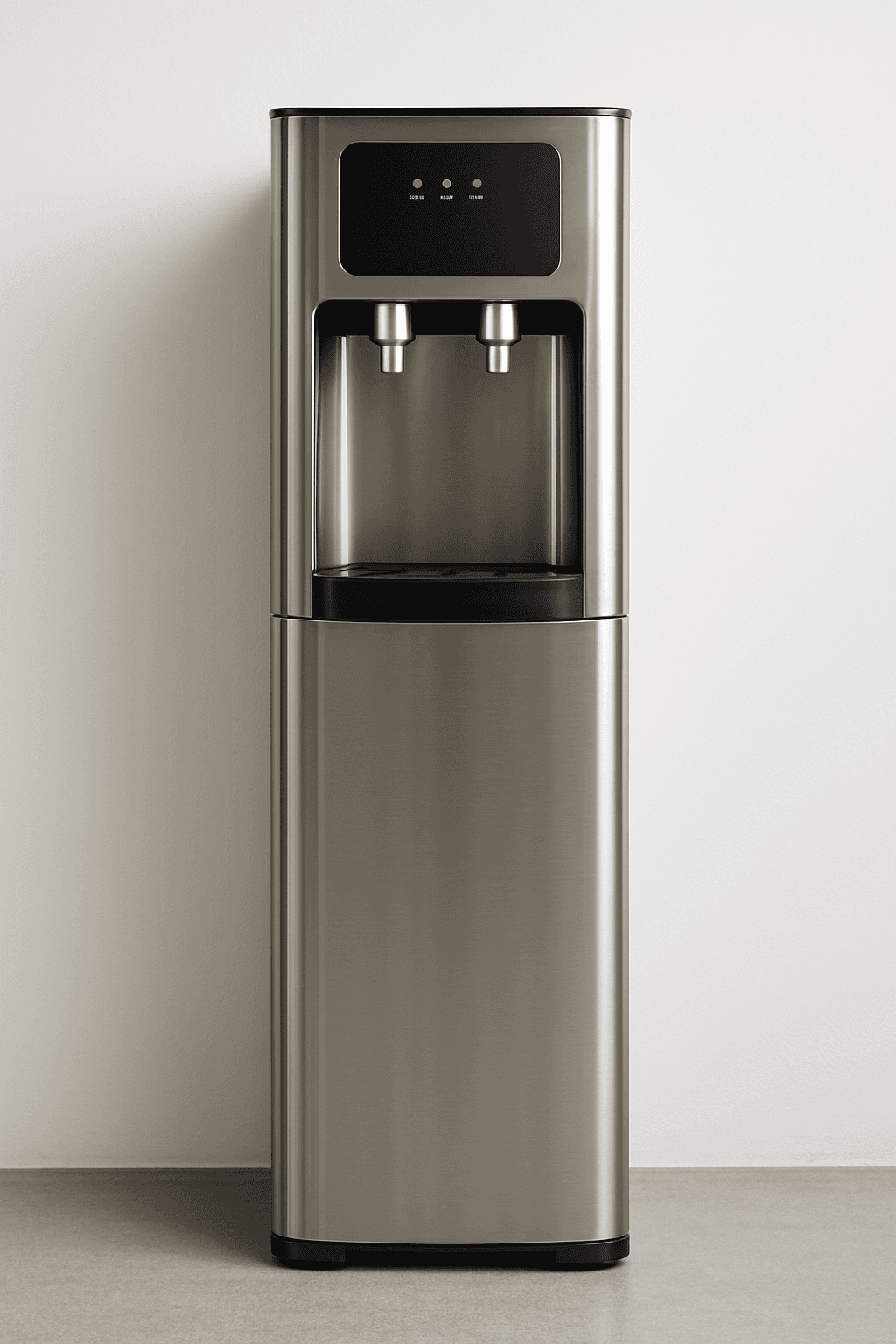
Freestanding units are the most common type in commercial settings. They stand independently, handle both bottled and plumbed-in supply, and suit high-volume zones comfortably. Large offices, hotel lobbies, and corporate reception areas use them to serve dozens of people across the day. Most offer hot, cold, and room-temperature options.
Good fit for: offices of 50 or more people, hotel lobbies and conference centers, employee cafeterias, any high-traffic zone where demand is consistently high.
Worth knowing: needs a dedicated floor space. Bottled setups come with delivery and storage logistics.
4. Bottled Water Dispensers
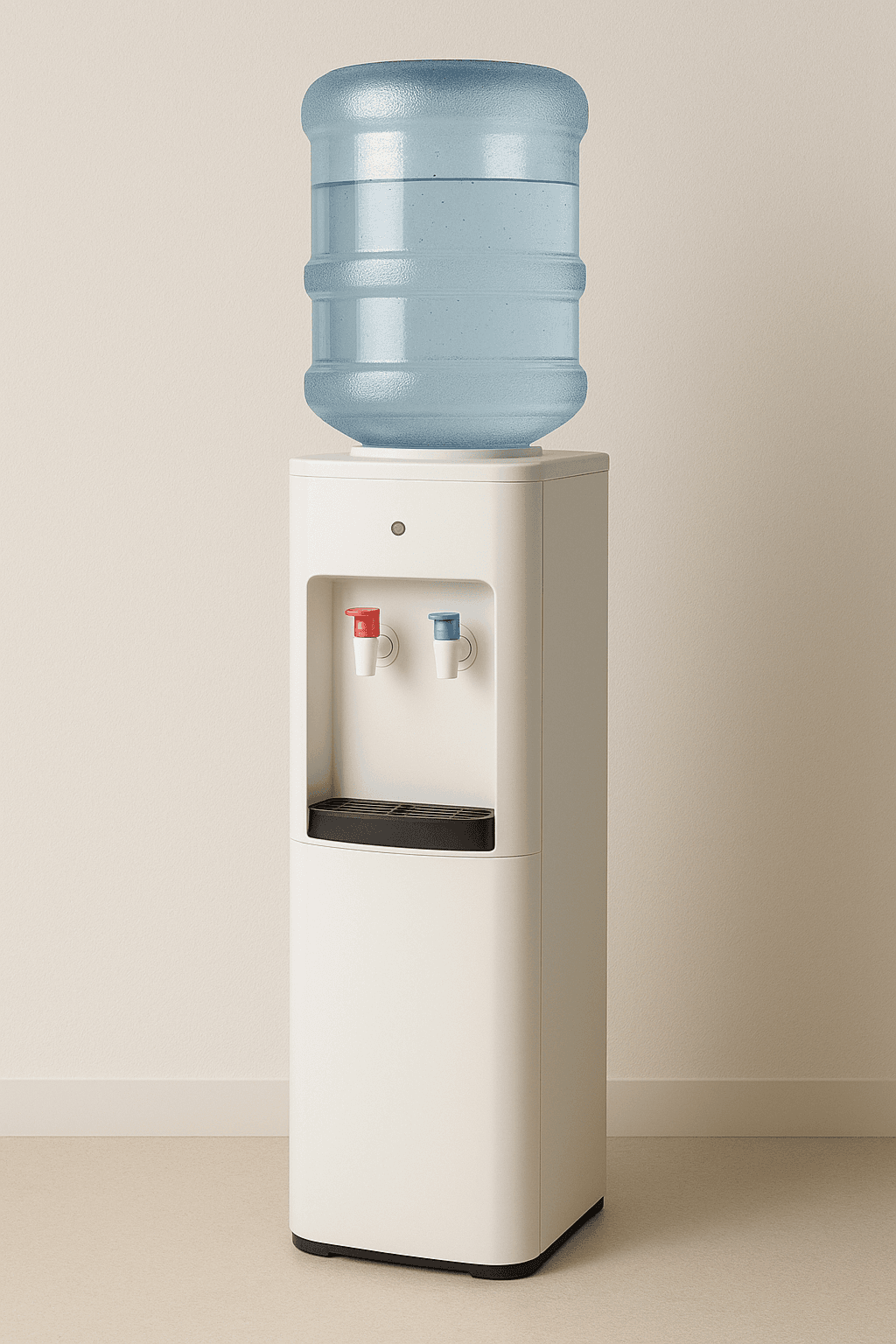
Bottled dispensers use replaceable three-to-five-gallon bottles, sit at the top or inside the unit, and don't need a water line. You plug in the unit, load a bottle, and you're dispensing — no plumber required.
That flexibility suits older buildings without accessible water lines, temporary workspaces, pop-up locations, or any site where plumbing changes aren't practical. When offices move or refit, bottled dispensers relocate without infrastructure concerns.
Good fit for: remote locations, construction sites, temporary offices, small businesses in older buildings, event venues, seasonal facilities.
Worth knowing: ongoing delivery coordination, plastic waste unless using returnable bottles, storage space for backup stock, and some physical effort changing heavy bottles.
5. Hot and Cold Dispensers

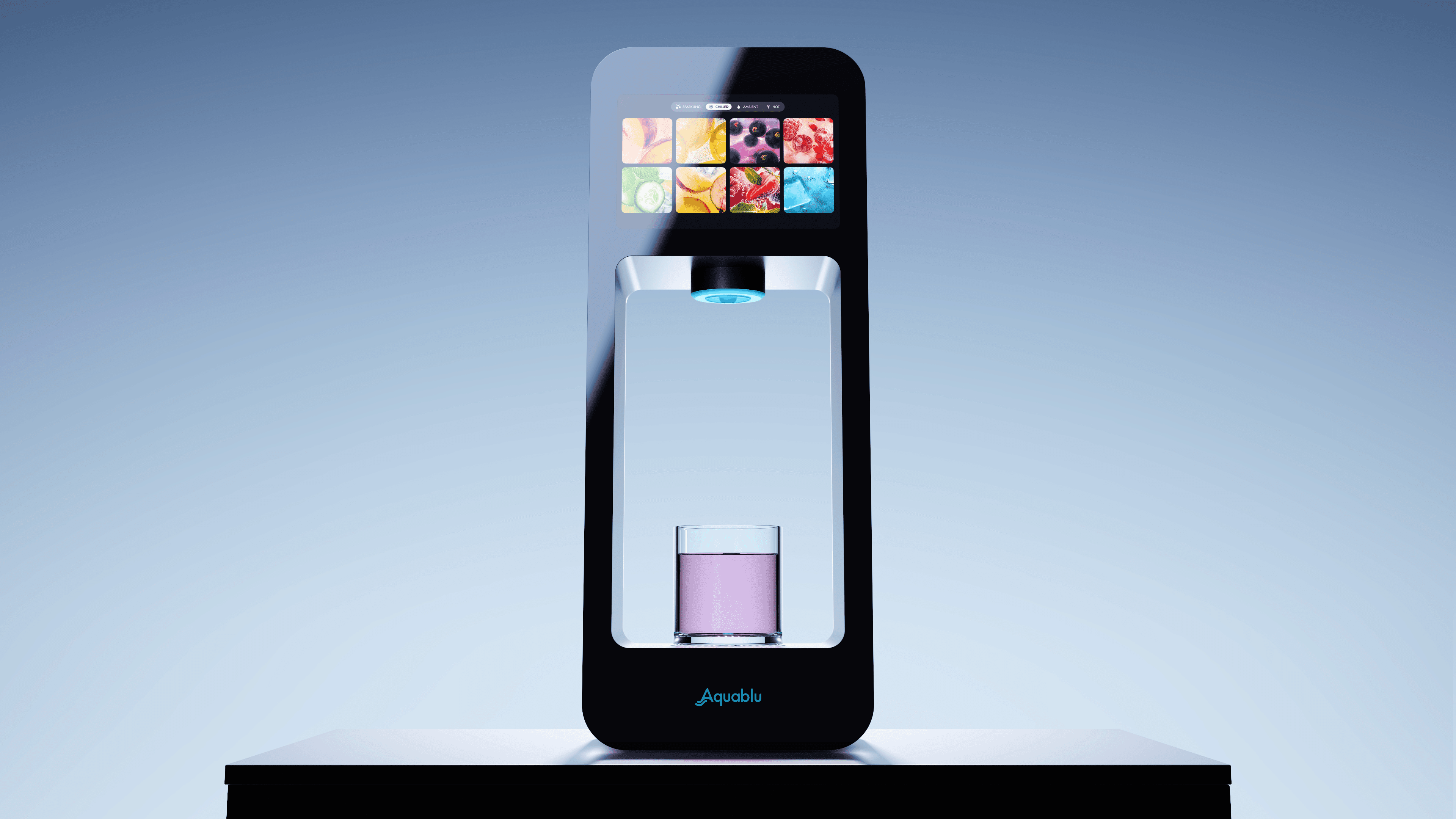
Hot and cold units provide dual-temperature from one system, covering hydration and beverage prep in one footprint. Aquablu's REFILL+ Series 2 adds sparkling water and over 60 vitamin-infused functional flavor combinations to that range — replacing the cooler, the kettle, and the soda fridge in one connection.
The pattern shows up across real offices. At STARP, a sports marketing agency, the switch to REFILL+ cut 100 cans a week, with sparkling becoming the team favorite. "I'm a big fan of the sparkling, and people are very bothered when it's not there," says Carolien van 't Hek, Managing Partner.
Good fit for: office kitchens and break rooms, hotel business centers, meeting rooms, co-working spaces — anywhere beverage variety drives consistent use.
Worth knowing: uses more energy than cold-only models. Heating and cooling components each need maintenance.
6. Bottom-Load Dispensers
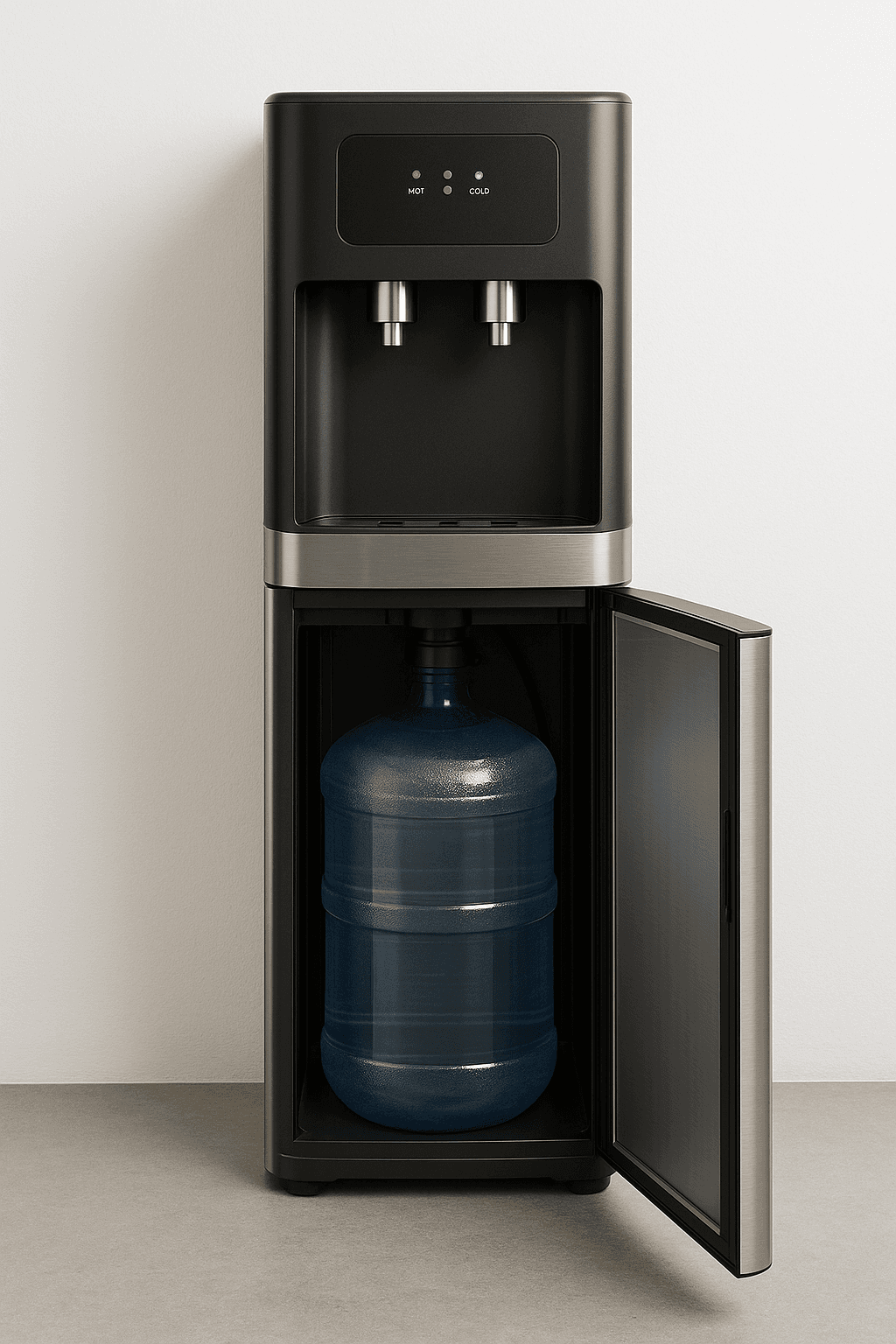
Bottom-load units position the bottle in a cabinet at the base. An internal pump draws water upward. No heavy lifting — instead of hoisting a 40-pound bottle to shoulder height, someone slides it in at waist level.
That ergonomic shift changes who does the refilling. More people are willing to swap a bottle they can slide in from below. The hidden bottle also creates a cleaner look in client-facing areas where a bulky top-mounted bottle would dominate the visual space.
Good fit for: offices that prioritize safety and ergonomics, reception areas and client-facing zones, facilities where maintenance is shared across the team.
Worth knowing: costs more upfront than top-load models. The base cabinet needs slightly more floor space, and the pump needs periodic maintenance.
7. Wall-Mounted Dispensers
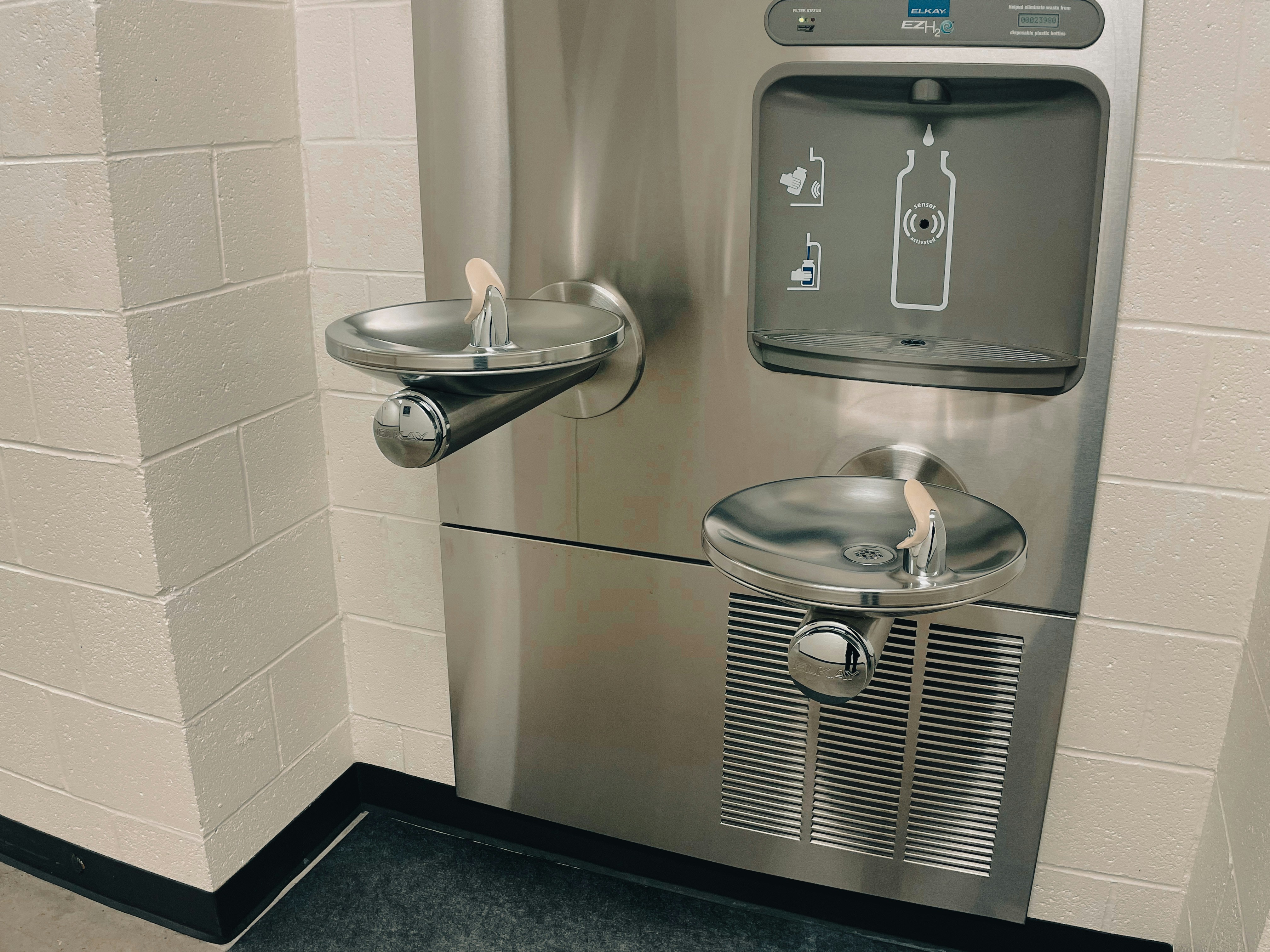
Wall-mounted units attach directly to walls, connect through in-wall plumbing, and free up the floor entirely. Narrow hallways, compact break rooms, and high-traffic cafeterias gain a hydration point without giving up any space for equipment or bottle storage.
Because they're plumbed-in, there are no deliveries to coordinate and no plastic waste. Fixed installation means reliable service with minimal ongoing admin once it's in.
Good fit for: hospitals and healthcare facilities, offices with limited square footage, school corridors and gyms, high-traffic hallways and waiting areas.
Worth knowing: needs professional installation with wall mounting and plumbing. Fixed position — moving it later is impractical.
8. Under-Sink Dispensers
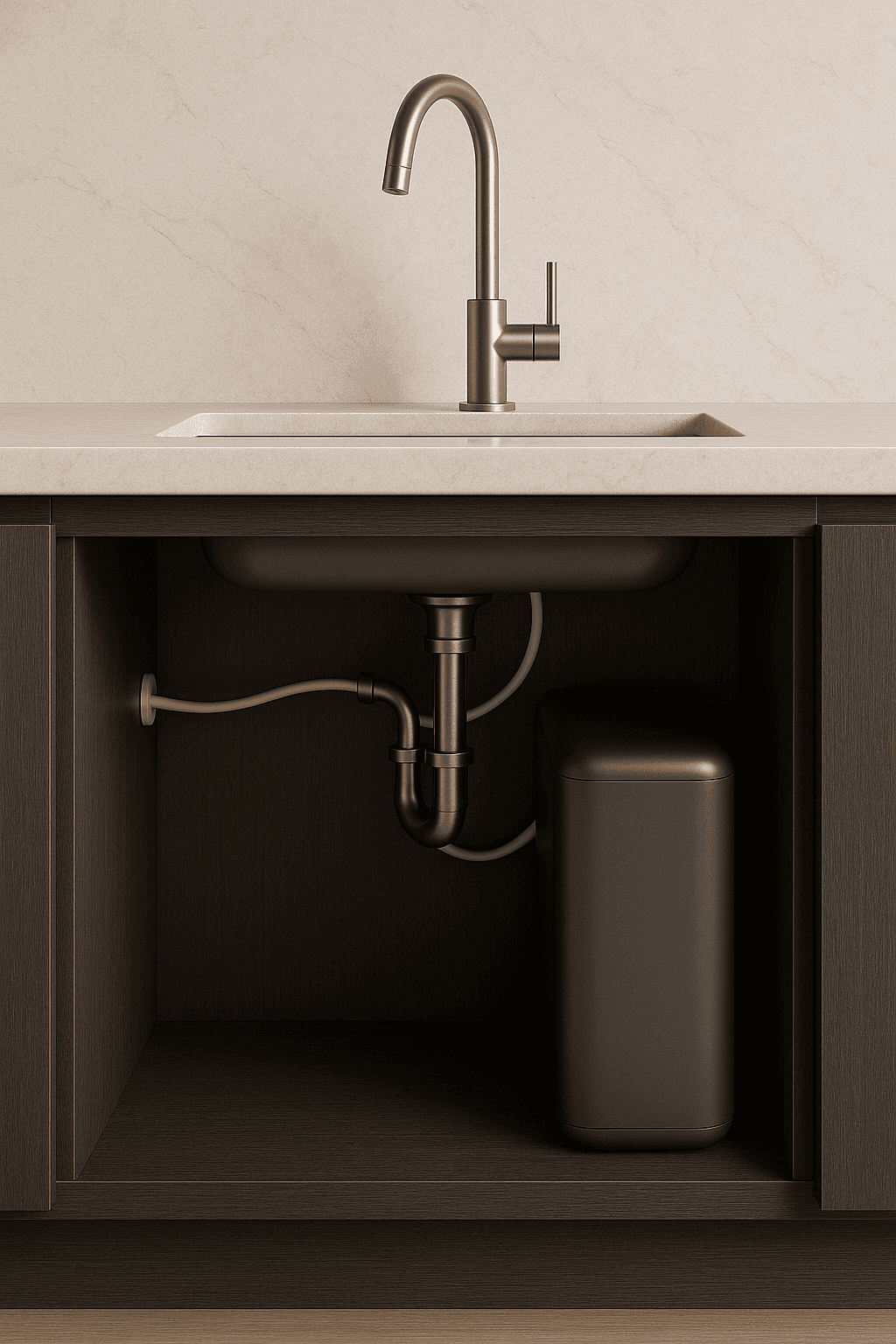
Under-sink units install in the cabinet below a countertop or sink, keeping the filtration system out of sight and delivering purified water through a dedicated tap at counter level. The surface stays clear. The water quality improves.
Hotel suites, executive offices, and compact kitchenettes use this approach to get filtered water without adding visible equipment to a space where counter room is already limited. The tap blends with existing fixtures.
Good fit for: hotel suites and guest rooms, executive offices, residential-style office kitchens, any environment where premium water quality meets a need for a clean look.
Worth knowing: needs professional installation with plumbing changes and regular filter cartridge replacements. More setup cost than portable options.
9. Integrated Dispensers
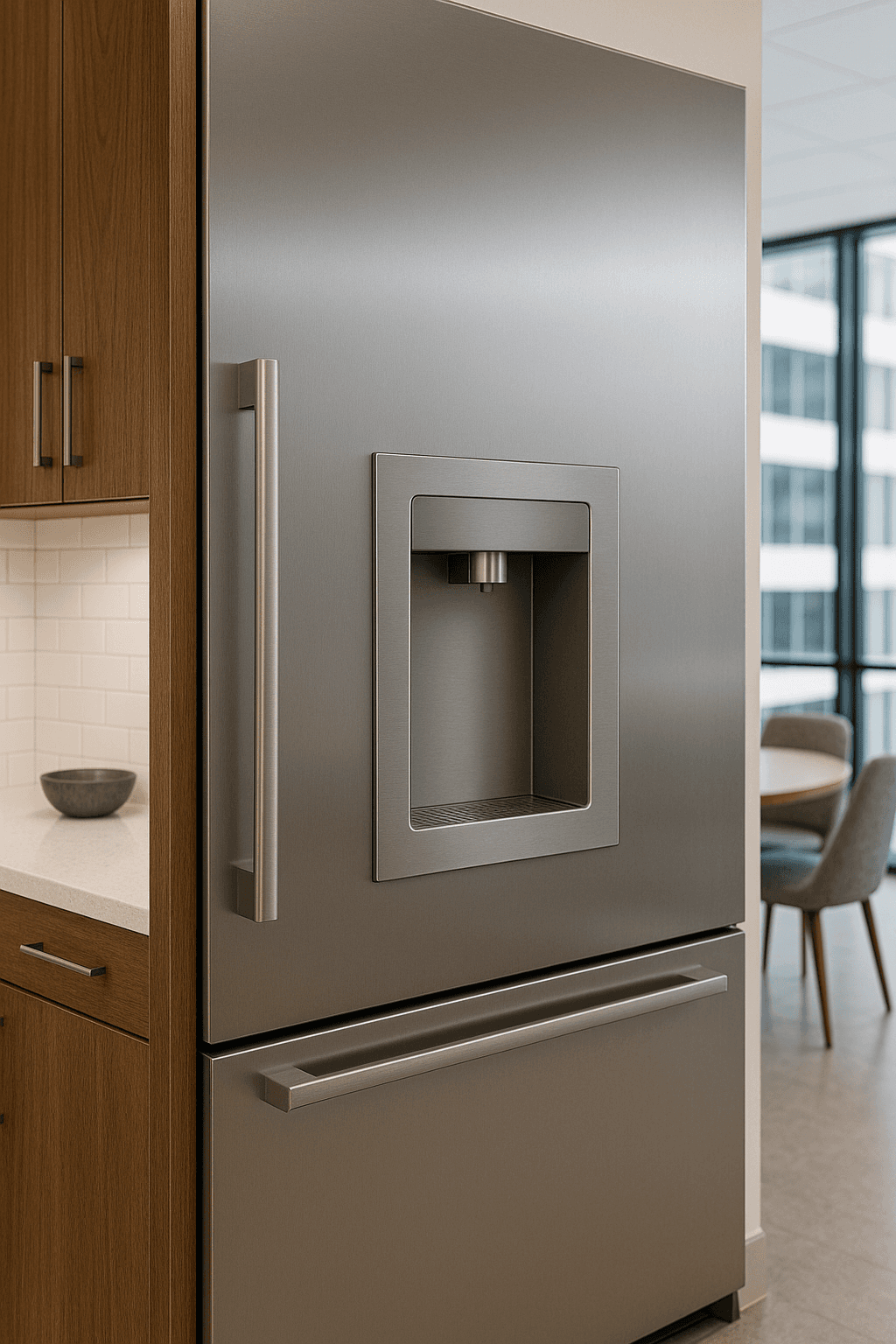
Integrated units embed directly into existing joinery — fridge doors, kitchen cabinetry, or custom millwork. The dispenser becomes an architectural element rather than standalone equipment. No visual clutter. No separate appliance to account for.
Design-led workplaces and high-end co-working spaces use this approach to keep the dispenser from interrupting the room's language. Every element reflects the same attention to detail.
Good fit for: high-end corporate offices and executive suites, boutique hotels, design-forward tech campuses, any premium space where the product should disappear into the environment.
Worth knowing: higher upfront investment for custom design and installation. Requires planning and construction coordination. Difficult to relocate once built in.
10. Portable Dispensers
Portable units move between locations. Lightweight, compact, with built-in handles or wheels — they need only an electrical outlet or nothing at all to run. Event coordinators move them between conference rooms and outdoor venues across the day. Construction site managers shift them as work zones change.
Their value is flexibility: any layout, any temporary location, zero installation. The plug-and-play setup means anyone can move and deploy them without specialist help.
Good fit for: corporate events and trade shows, outdoor activities, remote job sites, flexible co-working environments, seasonal operations — anywhere mobility outweighs capacity.
Worth knowing: smaller water capacity means more frequent refills. Multi-temperature options are limited on most portable models.
How to Choose the Right One
Three questions narrow the field fast.
Do you have plumbing access? If yes, plumbed-in options (point-of-use, wall-mounted, under-sink, integrated) give you unlimited supply, no deliveries, and no plastic waste. If no — or if you're in a temporary space — bottled or portable works.
How much space can you give up? Countertop for surfaces. Freestanding for floor zones. Wall-mounted or under-sink where neither is available. Bottom-load where the look matters as much as the function.
How much admin can your team absorb? More on that below.
How Much Admin Will It Create
It's the question facility managers ask first. Answer it by looking at the service model, not the sales sheet. Three things to check on any system: how often it needs a scheduled visit, how much upkeep the office can do itself, and whether the supplier can see a fault before you report it.
A connected, mains system should score well on all three. REFILL+ Series 2 runs on 2 scheduled maintenance visits per year, the flavor line clean is a 12-minute on-screen routine the office runs itself, and filter changes are scheduled by usage rather than the calendar. Because every pour streams to AURA, most faults are flagged and resolved before anyone on-site notices.
→ More detail on the service model
"Asking an FM to replace a filter on a schedule or do a stock take doesn't actually tell you what's going on with the system. When you're tracking every dispense you get the full picture. So instead of waiting for someone to report a problem, we already know about it and can get ahead of it."
— Ashlyn Kennedy, Product Manager, Aquablu
Will the Team Actually Use It
A dispenser only pays back if people drink from it, and variety is what turns a one-time novelty into a daily habit. A basic cooler pours one thing, so the soda fridge stays. A system with still, sparkling, and flavored options gives people a reason to come back.
The pattern shows up across real offices. At STARP, a sports marketing agency, the switch cut 100 cans a week, and sparkling became the team favorite.
"I'm a big fan of the sparkling, and people are very bothered when it's not there."
— Carolien van 't Hek, Managing Partner, STARP
At Visma YouServe, one unit went into the heart of the office cafe after a move, in a building that had been running at 20% occupancy on a typical day.
"We wanted the workplace to be fun again — a place where you meet colleagues, play a game, have a chat at the coffee machine... or now, the Aquablu machine."
— Ingeborg Brandsma, Marketing Manager, Visma YouServe
The Cost Question, and the Break-Even
The real hesitation is cost. Honest answer: below 25 people, a basic cooler is cheaper. Above it, the per-drink economics shift, and the gap widens as your team grows.
Here's what that looks like in practice. A 25-person office going through 1,000 drinks a month pays around €800 on bottled delivery. REFILL+ Kickstart is €390 a month - a saving of €410 from day one, with no setup fee and no hardware cost to recover first.
What we can see from a real switch: at STARP, overall drink costs stayed roughly the same, but the value felt higher. Fewer complaints, less waste, more consistent use across the team.
Run your own numbers in the ROI calculator. 60 seconds, no form.
When a Dispenser Is the Wrong Choice
A connected tap isn't right for every office:
Under about 25 people, or light usage. Below that, a basic plumbed cooler or a quality filter jug usually wins on total cost.
Very small or low-traffic sites. If only a handful of people are in on a given day, you're paying for capacity you won't use.
Not sure which side of the line you're on? A quick call is more honest than a one-size-fits-all quote. Book a call with Aquablu
Where REFILL+ Series 2 Fits
If you've worked through size, space, admin, and cost — and a connected mains system is the answer — REFILL+ Series 2 is built for exactly that decision.
It replaces what most offices are running across three or four separate units: chilled still, sparkling, hot, and flavored vitamin water, from one point-of-use tap, countertop or built-in. Install is a single service visit. For sites without plumbing, a Smart Jerrycan makes it standalone.
Every pour is logged — which means maintenance is triggered by actual usage rather than a calendar, and every litre is exportable for CSRD, GRI, or in-house sustainability reporting without anyone having to count anything.
The Next Step
Run the numbers for your office in 60 seconds with the ROI calculator, no form. It shows what a 25, 50, 100, or 250-person office costs on REFILL+ Series 2 against your current spend.
Prefer to talk it through? Book a 15-minute demo and we'll come to you.
The 10 Types of Water Dispensers
1. Plumbed-In (Point-of-Use) Dispensers
Plumbed-in dispensers connect directly to your building's water supply — no deliveries, no bottle storage, no recycling run. They filter water on demand, removing contaminants like microplastics, bacteria, and heavy metals, and deliver still, chilled, or sparkling water instantly.
Aquablu's REFILL+ connects to your water line and uses Nano-Silver Filtration to remove 99.9% of contaminants, with automatic UV cleaning running continuously at the dispensing point.
Good fit for: offices with plumbing access, hotels with consistent guest traffic, corporate headquarters, any site where daily demand justifies the setup.
Worth knowing: needs professional installation and scheduled filter changes. Higher upfront cost than bottled options.
2. Countertop Dispensers
Countertop units sit on a desk, counter, or kitchen surface. They don't take up floor space, work with small bottles or a mains connection, and move easily when layouts change.
Small offices, hotel café areas, and meeting rooms use them well — compact and accessible without requiring a dedicated zone. Many models offer hot and cold, which covers coffee breaks and cold drinks from one point.
Good fit for: teams of five to 15 people, hotel guest lounges, executive suites, conference rooms where counter space is easier to give up than floor space.
Worth knowing: lower water capacity. In busier settings, expect more frequent bottle changes or refills.
3. Freestanding Dispensers
Freestanding units are the most common type in commercial settings. They stand independently, handle both bottled and plumbed-in supply, and suit high-volume zones comfortably. Large offices, hotel lobbies, and corporate reception areas use them to serve dozens of people across the day. Most offer hot, cold, and room-temperature options.
Good fit for: offices of 50 or more people, hotel lobbies and conference centers, employee cafeterias, any high-traffic zone where demand is consistently high.
Worth knowing: needs a dedicated floor space. Bottled setups come with delivery and storage logistics.
4. Bottled Water Dispensers
Bottled dispensers use replaceable three-to-five-gallon bottles, sit at the top or inside the unit, and don't need a water line. You plug in the unit, load a bottle, and you're dispensing — no plumber required.
That flexibility suits older buildings without accessible water lines, temporary workspaces, pop-up locations, or any site where plumbing changes aren't practical. When offices move or refit, bottled dispensers relocate without infrastructure concerns.
Good fit for: remote locations, construction sites, temporary offices, small businesses in older buildings, event venues, seasonal facilities.
Worth knowing: ongoing delivery coordination, plastic waste unless using returnable bottles, storage space for backup stock, and some physical effort changing heavy bottles.
5. Hot and Cold Dispensers
Hot and cold units provide dual-temperature from one system, covering hydration and beverage prep in one footprint. Aquablu's REFILL+ Series 2 adds sparkling water and over 60 vitamin-infused functional flavor combinations to that range — replacing the cooler, the kettle, and the soda fridge in one connection.
The pattern shows up across real offices. At STARP, a sports marketing agency, the switch to REFILL+ cut 100 cans a week, with sparkling becoming the team favorite. "I'm a big fan of the sparkling, and people are very bothered when it's not there," says Carolien van 't Hek, Managing Partner.
Good fit for: office kitchens and break rooms, hotel business centers, meeting rooms, co-working spaces — anywhere beverage variety drives consistent use.
Worth knowing: uses more energy than cold-only models. Heating and cooling components each need maintenance.
6. Bottom-Load Dispensers
Bottom-load units position the bottle in a cabinet at the base. An internal pump draws water upward. No heavy lifting — instead of hoisting a 40-pound bottle to shoulder height, someone slides it in at waist level.
That ergonomic shift changes who does the refilling. More people are willing to swap a bottle they can slide in from below. The hidden bottle also creates a cleaner look in client-facing areas where a bulky top-mounted bottle would dominate the visual space.
Good fit for: offices that prioritize safety and ergonomics, reception areas and client-facing zones, facilities where maintenance is shared across the team.
Worth knowing: costs more upfront than top-load models. The base cabinet needs slightly more floor space, and the pump needs periodic maintenance.
7. Wall-Mounted Dispensers
Wall-mounted units attach directly to walls, connect through in-wall plumbing, and free up the floor entirely. Narrow hallways, compact break rooms, and high-traffic cafeterias gain a hydration point without giving up any space for equipment or bottle storage.
Because they're plumbed-in, there are no deliveries to coordinate and no plastic waste. Fixed installation means reliable service with minimal ongoing admin once it's in.
Good fit for: hospitals and healthcare facilities, offices with limited square footage, school corridors and gyms, high-traffic hallways and waiting areas.
Worth knowing: needs professional installation with wall mounting and plumbing. Fixed position — moving it later is impractical.
8. Under-Sink Dispensers
Under-sink units install in the cabinet below a countertop or sink, keeping the filtration system out of sight and delivering purified water through a dedicated tap at counter level. The surface stays clear. The water quality improves.
Hotel suites, executive offices, and compact kitchenettes use this approach to get filtered water without adding visible equipment to a space where counter room is already limited. The tap blends with existing fixtures.
Good fit for: hotel suites and guest rooms, executive offices, residential-style office kitchens, any environment where premium water quality meets a need for a clean look.
Worth knowing: needs professional installation with plumbing changes and regular filter cartridge replacements. More setup cost than portable options.
9. Integrated Dispensers
Integrated units embed directly into existing joinery — fridge doors, kitchen cabinetry, or custom millwork. The dispenser becomes an architectural element rather than standalone equipment. No visual clutter. No separate appliance to account for.
Design-led workplaces and high-end co-working spaces use this approach to keep the dispenser from interrupting the room's language. Every element reflects the same attention to detail.
Good fit for: high-end corporate offices and executive suites, boutique hotels, design-forward tech campuses, any premium space where the product should disappear into the environment.
Worth knowing: higher upfront investment for custom design and installation. Requires planning and construction coordination. Difficult to relocate once built in.
10. Portable Dispensers
Portable units move between locations. Lightweight, compact, with built-in handles or wheels — they need only an electrical outlet or nothing at all to run. Event coordinators move them between conference rooms and outdoor venues across the day. Construction site managers shift them as work zones change.
Their value is flexibility: any layout, any temporary location, zero installation. The plug-and-play setup means anyone can move and deploy them without specialist help.
Good fit for: corporate events and trade shows, outdoor activities, remote job sites, flexible co-working environments, seasonal operations — anywhere mobility outweighs capacity.
Worth knowing: smaller water capacity means more frequent refills. Multi-temperature options are limited on most portable models.
How to Choose the Right One
Three questions narrow the field fast.
Do you have plumbing access? If yes, plumbed-in options (point-of-use, wall-mounted, under-sink, integrated) give you unlimited supply, no deliveries, and no plastic waste. If no — or if you're in a temporary space — bottled or portable works.
How much space can you give up? Countertop for surfaces. Freestanding for floor zones. Wall-mounted or under-sink where neither is available. Bottom-load where the look matters as much as the function.
How much admin can your team absorb? More on that below.
How Much Admin Will It Create
It's the question facility managers ask first. Answer it by looking at the service model, not the sales sheet. Three things to check on any system: how often it needs a scheduled visit, how much upkeep the office can do itself, and whether the supplier can see a fault before you report it.
A connected, mains system should score well on all three. REFILL+ Series 2 runs on 2 scheduled maintenance visits per year, the flavor line clean is a 12-minute on-screen routine the office runs itself, and filter changes are scheduled by usage rather than the calendar. Because every pour streams to AURA, most faults are flagged and resolved before anyone on-site notices.
→ More detail on the service model
"Asking an FM to replace a filter on a schedule or do a stock take doesn't actually tell you what's going on with the system. When you're tracking every dispense you get the full picture. So instead of waiting for someone to report a problem, we already know about it and can get ahead of it."
— Ashlyn Kennedy, Product Manager, Aquablu
Will the Team Actually Use It
A dispenser only pays back if people drink from it, and variety is what turns a one-time novelty into a daily habit. A basic cooler pours one thing, so the soda fridge stays. A system with still, sparkling, and flavored options gives people a reason to come back.
The pattern shows up across real offices. At STARP, a sports marketing agency, the switch cut 100 cans a week, and sparkling became the team favorite.
"I'm a big fan of the sparkling, and people are very bothered when it's not there."
— Carolien van 't Hek, Managing Partner, STARP
At Visma YouServe, one unit went into the heart of the office cafe after a move, in a building that had been running at 20% occupancy on a typical day.
"We wanted the workplace to be fun again — a place where you meet colleagues, play a game, have a chat at the coffee machine... or now, the Aquablu machine."
— Ingeborg Brandsma, Marketing Manager, Visma YouServe
The Cost Question, and the Break-Even
The real hesitation is cost. Honest answer: below 25 people, a basic cooler is cheaper. Above it, the per-drink economics shift, and the gap widens as your team grows.
Here's what that looks like in practice. A 25-person office going through 1,000 drinks a month pays around €800 on bottled delivery. REFILL+ Kickstart is €390 a month - a saving of €410 from day one, with no setup fee and no hardware cost to recover first.
What we can see from a real switch: at STARP, overall drink costs stayed roughly the same, but the value felt higher. Fewer complaints, less waste, more consistent use across the team.
Run your own numbers in the ROI calculator. 60 seconds, no form.
When a Dispenser Is the Wrong Choice
A connected tap isn't right for every office:
Under about 25 people, or light usage. Below that, a basic plumbed cooler or a quality filter jug usually wins on total cost.
Very small or low-traffic sites. If only a handful of people are in on a given day, you're paying for capacity you won't use.
Not sure which side of the line you're on? A quick call is more honest than a one-size-fits-all quote. Book a call with Aquablu
Where REFILL+ Series 2 Fits
If you've worked through size, space, admin, and cost — and a connected mains system is the answer — REFILL+ Series 2 is built for exactly that decision.
It replaces what most offices are running across three or four separate units: chilled still, sparkling, hot, and flavored vitamin water, from one point-of-use tap, countertop or built-in. Install is a single service visit. For sites without plumbing, a Smart Jerrycan makes it standalone.
Every pour is logged — which means maintenance is triggered by actual usage rather than a calendar, and every litre is exportable for CSRD, GRI, or in-house sustainability reporting without anyone having to count anything.
The Next Step
Run the numbers for your office in 60 seconds with the ROI calculator, no form. It shows what a 25, 50, 100, or 250-person office costs on REFILL+ Series 2 against your current spend.
Prefer to talk it through? Book a 15-minute demo and we'll come to you.
FAQ
01
What size office is a connected water dispenser built for?
REFILL+ Series 2 is built for offices over 25 people. Below that, a basic plumbed cooler or quality filter jug usually wins on total cost. Above it, the per-drink economics, the variety, and the admin savings tip the balance, and the gap grows with headcount. Smaller team? A quick call will tell you honestly whether it fits.
02
Is a mains-connected dispenser cheaper than a bottled cooler?
For offices above 25 people with mains access, mains-connected wins on cost, admin, and reporting. For example, at 1,000 drinks a month, that's €800 in bottled delivery down to €390 with Kickstart subscription - saving €410 a month from day one. No delivery schedule, no bottles to recycle, consistent filtered taste, plus chilled, sparkling, hot, and flavored vitamin water from one counter.
03
Does it need a plumbing connection?
Mains-connected is the default, not a requirement. For sites without mains access there's a standalone setup with a Smart Jerrycan and pump. Either way, install is a single service visit.
04
How much upkeep does it need?
Two scheduled maintenance visits a year. Filter changes scheduled by usage; the flavor line clean is a 12-minute on-screen routine the office runs itself.
par
Valerie Loutphi, Senior Product Marketing Manager @Aquablu
Valerie Loutphi, Senior Product Marketing Manager @Aquablu
/
Aquablu connected-fleet data (AURA), European REFILL+ install base, last 12 months
Aquablu case studies: STARP, Visma YouServe — aquablu.com/case-studies.
Aquablu ROI calculator and rate card — /roi-calculator and /lp/pricing.
More stories
Keep up with the latest articles written about Aquablu


Prêt à améliorer votre hydratation ?
rejoignez le club
Prêt à améliorer votre hydratation ?
rejoignez le club
Prêt à améliorer votre hydratation ?