Earning the commute
Offices need to work harder than ever to earn the commute. Here's what the landscape looks like in 2026, and how to stay relevant.
Aquablu speaks with .re-group CEO Martijn Roordink on why an office move is a rare moment to add value and how, in 2026, designing for social connection and 24/7 custom usage is the answer to earning the commute.
It comes as no surprise to most that, post-Covid, the office landscape has shifted dramatically. While a five-day week full-time at the office desk was once a universal mandate, employees now have choice. The comforts of home on the menu mean offices need to work harder than ever to earn their keep.
The numbers back it up: 88% of people now work hybrid, according to the global workplace-experience benchmark Leesman (Focus Forward, 2025). Getting them through the door is harder, too. Leesman's Hybrid Future study (2024) found that for 49%, the commute discourages a trip in.
So, how can offices remain relevant when they’re no longer the only option? And how can office leaders leverage a move or expansion to maximise advantage?
To find the answers, we speak to the workplace expert team at .re-group’s work.club, starting with CEO Martijn Roordink who has been advocating for the reinvention of real estate since the early 2000s, well before the pandemic hit.
Having been recruited at global office space network Regus in the year 2000, Martijn began his first business in 2003, an operating platform delivering added-value services to the users of real estate. Within a couple of years it became the largest of its kind, growing into the company Spaces.
“Spaces was one of the first workspace philosophies built around design, music, like-minded people, and services that were better than what you had at home,” says Martijn.
“I sold that business in 2014, but I still had the urge to reinvent the industry," he says. Which led to .re-group, founded in 2020 with Michiel Brouwer, followed by its workspace platform work.club in 2025.
"Laat je vastgoed los," or “let go of your real estate.” That’s their signature line. It means what matters is not the four walls of the building itself, but delivering added value inside. “When I started Spaces, the benchmark was set by Google, Facebook, Twitter. Their philosophy for being the most attractive employer was: anything you want, we'll deliver. Wellness, gym, great food, anything. It was about keeping people inside, for productivity,” says Martijn.
“That's changed. People don't come to the office for the perks anymore, they come because they're people, and that's what we'd forgotten. You come for social connection, onboarding, energy, learning, even falling in love.”
The human element. It's what the convenience of working from home can't replace.


The numbers say the same. According to Leesman, the top reasons for coming to the office are meetings and collaboration (59%) and bonding or socialising (50%). 42% of employees feel socially disconnected from colleagues when working remotely ((The Hybrid Future, 2024).).
"A company is a movement. You're working for a story, to make change happen, and that can't happen if you're never there. But that means the office has to be somewhere people genuinely want to be," says Martijn.
"That's why we now use the work.club model. Becoming a member of a club gives you social connection, a sense of being part of something. The same should be true of a building."
What the shift looks like: The 24/7 space
Rather than an attempt to resist or beat hybrid, Martijn’s approach is to bring hybrid to the office itself; to create a multifunctional space for different working styles, moods, activities, and times of day.
“A building shouldn't serve just one narrow purpose. Ideally it's relevant 24/7,” says Martijn.
“So from a design point of view you have to create a hybrid philosophy.”
Martijn starts by envisioning all the various possibilities and learning what people genuinely want.
“You always work from a programme of demand and a growth 'wish' programme. And the design brief itself has changed,” he says. “In the past we built lots of open space. Because of Covid, Teams and Zoom, we now need many enclosed 'cell' spaces too.
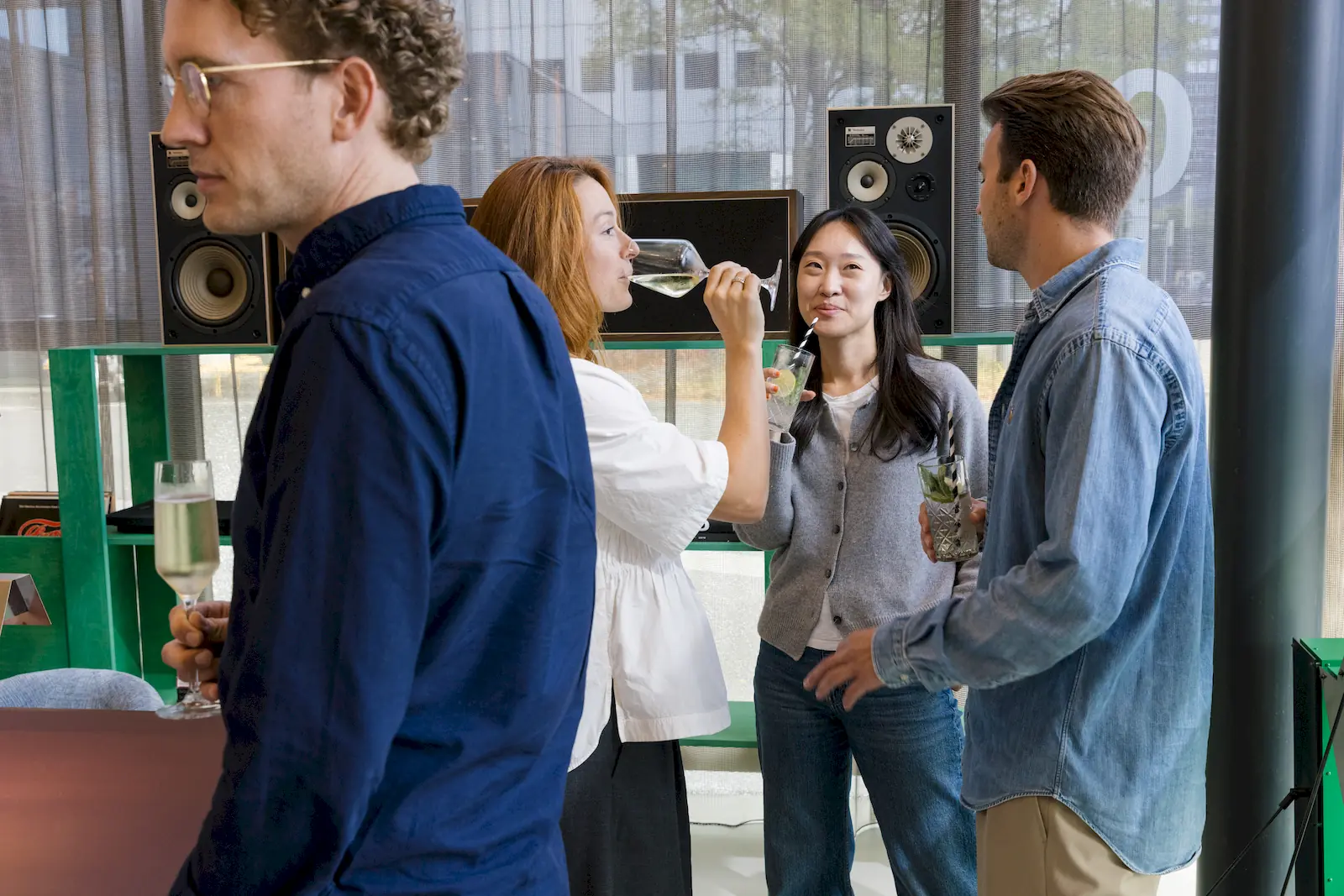
“What your design has to achieve is that it's social, attractive, dynamic, interactive, and full of choice. So you might have a cinema, a bar, a club space, enclosed meeting rooms, and you play with it.”
But variety alone doesn't earn the commute. Once the big moves are right, it comes down to the detail.
“It's the same principle behind Aquablu,” says Martijn.
“When I started Spaces, I had the best coffee experience in the world. But that's not enough anymore; you have to deliver the best of every experience.
“Hydration is part of that: non-alcoholic options, choice, something that makes a person feel special. Because it's never about the volume of people; it's about the one-on-one. Every single person is the person.”
The office may no longer be the only option. But a move, done well, is the moment to make it the one people choose. And that, Martijn argues, is worth every cent to get right.
More resources

Previous article
How to ask
CFOs are fielding many requests mid-move, so we asked our own about the best way to approach him when looking to make an upgrade for your office infrastructure.

Next article
Five rules for getting the space right
Twenty-five years and millions of square metres in, here are Martijn’s top lessons for planning a move - a quick map of what the rest of this guide unpacks.
Don't stop here
There's a lot more where this came from
You just read one article out of a whole edition, but the full edition is yours to download (for free)